
Geopolymer Foundations Last Decades Longer Than Steel
Quick Overview
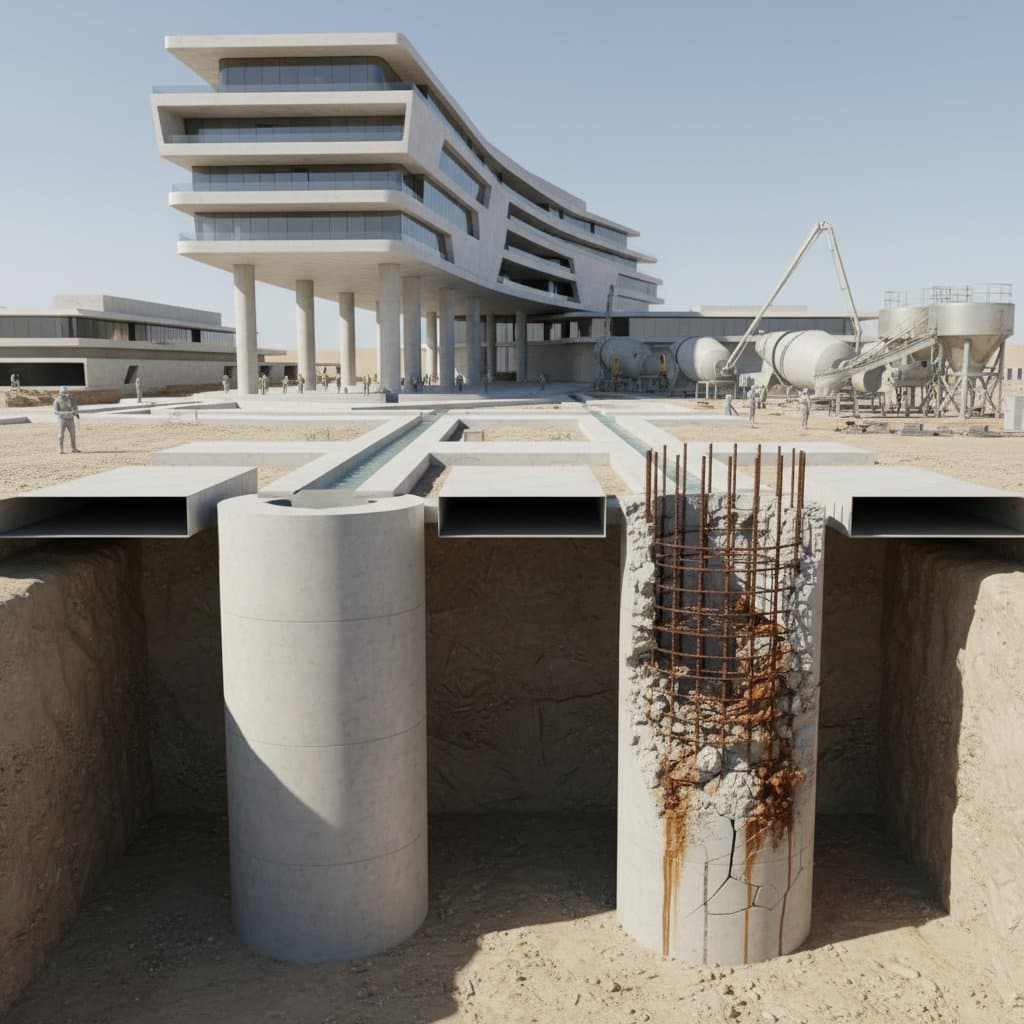
Steel-reinforced concrete structures often fail due to corrosion triggered by salt, moisture, and environmental exposure. Geopolymer concrete counters this vulnerability by eliminating steel reinforcement and forming a corrosion-resistant matrix. While initial costs may exceed those of traditional concrete by ten to twenty percent, the extended lifespan and reduced maintenance yield substantial long-term savings.
Inspection Guidelines
Evaluate foundations and structural slabs using systematic field assessments, similar to those applied to aging residential properties. Prioritize identification of water infiltration routes and chemical exposure risks before concluding that material degradation has occurred.
- Examine surfaces adjacent to soil or exposed to salt for absence of rust streaks, scaling, or spalling.
- Verify that runoff directs water away from the foundation perimeter, preventing pooling.
- Tap exposed concrete to ensure a solid resonance, free from hollow sounds indicating delamination.
- Observe areas where rebar typically causes discoloration; geopolymer maintains a uniform, neutral appearance.
- Inspect joints for cracks attributable to shrinkage or inadequate curing, rather than corrosion-induced patterns.
When contrasting conventional concrete with geopolymer, observe surface aging patterns. Geopolymer retains a compact, stone-like texture over extended periods.
Warning Signs of Distress
Recognize early indicators of potential failure to address issues proactively.
- Rust stains or bubbling paint along foundation edges signal internal corrosion.
- Flaking or softened areas where salts accumulate indicate binder degradation.
- Persistent efflorescence that reappears post-cleaning suggests ongoing moisture migration.
- Drainage configurations that redirect water toward structural walls exacerbate exposure.
- Cracks aligned with reinforcement locations point to steel expansion from rust.
- Variations in color or texture imply inconsistent mixing or curing processes.
These symptoms highlight interactions between water, chemistry, and embedded materials. A well-executed geopolymer system mitigates such risks through its inherent stability.
Repair Options and Estimated Costs
Once corrosion initiates in steel-reinforced systems, superficial repairs offer limited efficacy. Removing deteriorated rebar, applying corrosion inhibitors, and overlaying with repair mortar typically costs several thousand dollars per affected section. Complete replacement escalates expenses by a factor of ten or more.
Geopolymer installations carry a higher upfront premium due to specialized materials and precise placement. Savings accrue from obviating steel needs, minimizing upkeep, and extending service life.
Standard repair approaches include:
- Surface spalling: Apply compatible geopolymer mortar at approximately ten to fifteen dollars per square foot.
- Shrinkage-induced cracking: Inject epoxy resin or sealant for under five dollars per linear foot.
- Chemical degradation: Excise compromised sections and reinstall with alkali-activated blends, ranging from twenty to thirty dollars per square foot.
Surface treatments, such as coatings over corroded steel or external sealants, seldom provide lasting solutions. They conceal underlying problems without resolving root causes, often leading to escalated repair scopes.
Deciding Between Repair and Replacement
Assess concrete systems by evaluating structural integrity and chemical resilience. Preserve sound elements and replace those showing irreversible compromise.
- Reinforced concrete: Opt for replacement if rebar corrosion or loss of bond integrity is evident, as patching proves inadequate.
- Geopolymer concrete: Limit repairs to isolated mechanical damage or placement errors; the stable chemistry prevents flaw propagation.
- Foundation elements: Address drainage deficiencies through grading adjustments and water management prior to material interventions. Many attributed failures stem from hydrological issues rather than inherent material weaknesses.
Geopolymer foundations mimic the resilience of natural stone, enduring freeze-thaw cycles, salt intrusion, and sulfate assaults. With proper formulation and moisture protection during curing, replacement becomes unnecessary.
Assembling the Right Team and Workflow
Select professionals versed in the unique properties of alkali-activated materials to ensure project success.
- Engage an engineer or inspector experienced with geopolymer formulations to validate mix designs and curing methods.
- Contract a specialist in geopolymer pours; conventional concrete teams can transition with guidance, but initial supervision is essential.
- Involve an architect or structural engineer for verifying load distribution and design details.
- For retrofits transitioning from traditional concrete, partner with a general contractor to manage sequencing and adapt existing formwork.
Conduct parallel evaluations of proposals to compare approaches and pricing. Incorporating professional project oversight, which adds ten to twenty percent to costs, safeguards against pour failures.
Prioritizing Project Scope
Target enhancements that bolster durability and control moisture for optimal returns.
- Enhance site grading ahead of foundation work to promote natural drainage.
- Integrate perimeter drainage systems and vapor barriers to maintain a dry subgrade.
- Specify geopolymer for footings, grade beams, and slabs in high-corrosion environments.
- Postpone aesthetic treatments until the core structure achieves full cure and stability.
- Refrain from basement expansions where persistent water threats exist.
Investments in superficial elements, such as stains or overlays, yield minimal durability benefits. Direct resources toward foundational components that sustain long-term value.
Budgeting and Phased Execution
Sequence tasks methodically to support curing integrity and avoid contamination.
- Manage water flow: Establish trench drains, gutters, and grading adjustments before commencing excavation.
- Condition the subgrade: Compact the soil, place vapor barriers, and confirm proper slopes.
- Execute the pour: Regulate temperature and humidity throughout the curing phase.
- Verify structural quality: Perform tap tests and, if required, core sampling for density assessment.
- Backfill post-cure: Wait until full strength develops to prevent load-induced cracking.
- Apply protective layers: Incorporate insulation and waterproofing with vapor-permeable membranes to facilitate gradual drying.
The primary hazard lies in premature actions. Geopolymer strength develops via internal reactions, distinct from surface evaporation; early form removal risks compromising adhesion.
Fundamentals of Geopolymer Materials
Geopolymer concrete derives from industrial byproducts including fly ash, slag, and calcined clays, activated by alkaline solutions. This process yields a robust aluminosilicate framework impervious to corrosion and chemical erosion. Unlike Portland cement, it avoids calcium hydroxide, which erodes in acidic or saline conditions.
Moderate-load designs eliminate internal steel, substituting with fibers or basalt mesh for reinforcement. This approach eradicates corrosion origins entirely.
Resulting foundations endure decades beyond steel-reinforced counterparts, even in aggressive settings like coastal or industrial areas, as evidenced by field observations showing negligible deterioration.
Strategies for Ongoing Upkeep
Geopolymer systems demand limited intervention, yet vigilance sustains performance.
- Maintain clear drainage channels to prevent blockages.
- Renew exterior protective coatings every ten years in exposed applications.
- Replace deteriorated joint sealants as they harden.
- Divert deicing salts from wall proximities.
- Survey adjacent vegetation to mitigate root penetration risks.
While chemically inert, geopolymer withstands corrosion but not ground shifts from unmanaged water or soil dynamics. Proactive hydrology preserves mechanical integrity.
Securing Lasting Value
Traditional concrete foundations initiate decline upon moisture contact with embedded steel, leading to expansive rust that fractures the matrix and perpetuates repairs. Geopolymer disrupts this progression, remaining inert, compact, and reliable. The initial investment recoups via extended service without interruptions.
For prospective builds, analyze site-specific soil chemistry and hydrology. In environments with salts, sulfates, or elevated groundwater, geopolymer emerges as the prudent selection.
Initiate evaluation by assessing drainage efficacy: gauge slopes directing water from foundations, verify downspout outlets, and identify salt-prone areas. By prioritizing water governance, selecting resilient materials, and adhering to precise workflows, structures achieve enduring reliability. Geopolymer foundations demonstrate that corrosion resistance integrates seamlessly into proven construction practices.