
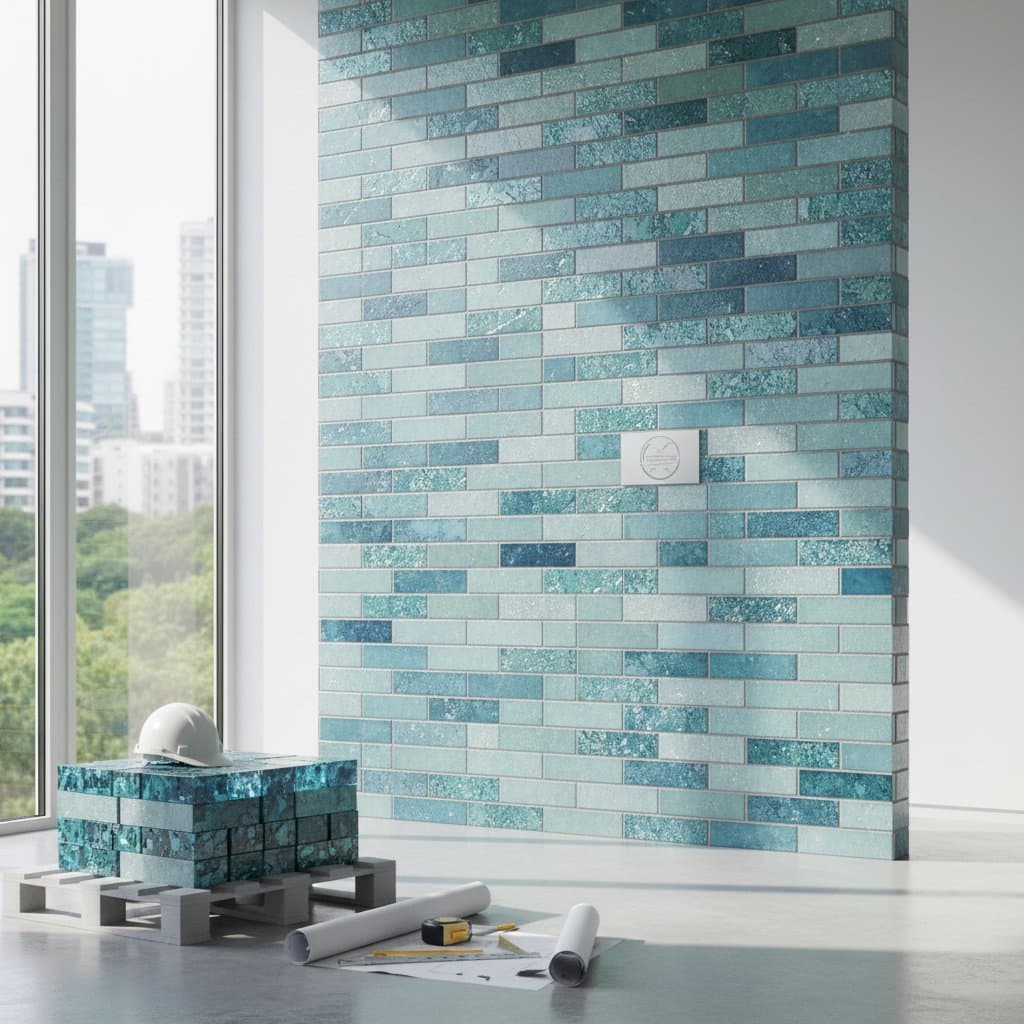
The Emergence of Recycled Glass in Sustainable Masonry
Builders and property owners increasingly select recycled glass for masonry projects that prioritize environmental stewardship alongside visual elegance. This material produces robust, eye-catching elements for walls, exteriors, and ornamental features. The following sections explain the mechanics of recycled glass masonry, its suitability as a building component, and strategies for effective planning, assembly, and upkeep to achieve lasting results.
Essential Insights
- Cost breakdown: Recycled glass masonry units range from 8 to 15 dollars per square foot, allocated as 60 percent for materials, 30 percent for labor, and 10 percent for tools or waste management.
- Installation duration: Professionals complete a 100 square foot wall in 2 to 3 days, encompassing curing and sealing phases.
- Composition details: Glass aggregates constitute 70 to 80 percent of the blend, secured with eco-friendly cement or geopolymer adhesives.
- Strength metrics: The material achieves compressive strength of 3000 to 5000 PSI, ideal for non-structural walls and aesthetic dividers.
- Selection criteria: Consider expenses, regional weather, aesthetic choices, and access to local recycled glass supplies.
Fundamentals of Recycled Glass Masonry
This approach incorporates pulverized or milled glass combined with cement-like or polymer binders to create bricks, blocks, or panels. Sources include used bottles, manufacturing byproducts, or surplus architectural glass. The outcome redirects landfill-bound waste and lessens reliance on new sand and aggregates.
Varieties of Recycled Glass Masonry Components
- Glass-infused concrete bricks: These incorporate fine or coarse glass grains in place of standard fillers, yielding a brick-like appearance with a gentle shimmer.
- Cast glass blocks: Formed by melting and molding reclaimed glass, they suit light-permeable interior dividers or outdoor highlights.
- Geopolymer-based glass blocks: These utilize alkali-activated binders that emit fewer greenhouse gases than traditional Portland cement.
Choices among these options hinge on required durability, surface treatments, and light diffusion properties, tailored to whether the application serves load-bearing, decorative, or thermal roles.
Project Planning for Recycled Glass Masonry
Verify compliance with regional regulations before proceeding, as authorities often approve recycled materials for non-load-bearing uses, though engineered validation may apply to weight-bearing elements.
Regulatory Approvals
Consult local building authorities regarding fire resistance, thermal efficiency, and load-testing requirements. Numerous systems adhere to ASTM C1634 standards for glass-based units, yet jurisdiction-specific rules differ.
Financial and Supply Planning
Expect recycled glass units to cost 10 to 20 percent more than conventional concrete alternatives. Prices fluctuate based on hue, light transmission, and bespoke shaping. Collaborate with nearby recycling facilities or sustainable suppliers for volume discounts on major undertakings. Confirm that post-consumer glass exceeds 60 percent to qualify for green building credentials.
Required Materials and Tools
- Recycled glass units: Choose dimensions and textures that align with the intended design.
- Adhesive mixture: Select mortar or geopolymer variants compatible with glass surfaces.
- Support elements: Include mesh or rebar for walls exceeding 4 feet in height or exposed to side forces.
- Protective coating: Opt for transparent, UV-stable sealants to guard against water penetration.
- Personal protective equipment: Employ gloves, goggles, and respirators when managing sharp glass particles.
- Alignment instruments: Use levels and spacers to ensure even gaps and straight lines.
Site Preparation and Base Setup
Establish a firm, even foundation to bear the wall's weight. For indoor barriers, align with existing framework; outdoor setups demand drainage layers or footings buried at least 6 inches below ground level.
- Clear and grade the space: Eliminate obstacles, assess gradients, and outline the wall's position.
- Install the base: Cast a concrete slab at minimum 8 inches depth for modest walls, or adhere to code for expansive ones.
- Test dry placement: Position the initial layer of units sans adhesive to evaluate intervals and compatibility.
Detailed Installation Process
- Prepare adhesive: Blend mortar uniformly, then apply a 1/2 inch bed on the base before laying the bottom row.
- Position units: Seat each piece securely, employing spacers for consistent joint widths.
- Incorporate supports: Embed mesh or rebar at intervals of 2 to 3 layers to enhance fracture resistance.
- Remove surplus adhesive: Clean seams promptly to prevent residue buildup on surfaces.
- Allow setting: Permit 48 hours minimum before imposing weight or coatings, minimizing potential fissures from contraction.
- Apply protection: Coat with sealant to repel dampness and amplify the material's natural luster.
Ensuring Quality and Resolving Issues
Examine plumbness, seam uniformity, and setting uniformity throughout. Small edge nicks from transport can receive resin fillers. For adhesive residue, apply pH-neutral solutions; steer clear of acids that etch the glass.
Frequent challenges encompass:
- Irregular seams: Stem from poor base leveling; revisit the foundation and standardize spacer use.
- Fissures: Arise from hasty evaporation; moisten areas during the initial 48 hours.
- Tone inconsistencies: Occur with diverse glass origins; source homogeneous lots for uniform appearance.
Long-Term Care for Recycled Glass Structures
Upkeep remains simple: Wash exteriors biannually with gentle soap solutions. Evaluate coatings every 3 to 5 years, refreshing if moisture uptake rises. Monitor outdoor joints for wear or salt deposits. Well-executed installations endure 40 to 50 years.
Routine Evaluation Points
- Coating durability and shine preservation
- Seams cracked beyond 1/16 inch
- Evidence of water damage or fading
- Footing and support firmness
Deciding Between DIY and Expert Assembly
For novice builders, professional involvement ensures code adherence and optimal outcomes, particularly for heights over 3 feet or complex designs. DIY suits small, non-structural projects like garden borders, provided one masters basic masonry techniques. Weigh experience against project scale; hire certified installers for warranties and precision.
Advancing Sustainable Masonry Practices
Recycled glass masonry illustrates the integration of eco-innovation with practical building methods. Through informed material selection, ethical procurement, and diligent care, projects advance resource conservation and yield distinctive, resilient architecture.