
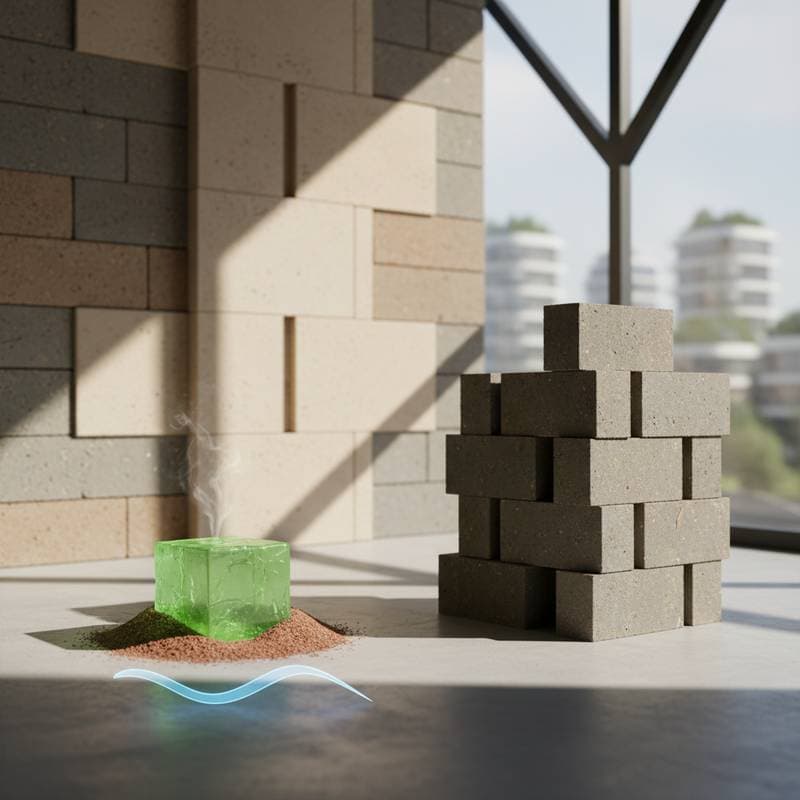
Introduction to Geopolymer Bricks
Geopolymer bricks represent a significant shift in masonry materials. These products replace traditional cement with binders derived from industrial byproducts such as fly ash and slag. Builders gain a masonry unit that cures rapidly while maintaining structural integrity over decades.
The material forms through a chemical reaction that activates aluminosilicate sources with alkaline solutions. This process occurs at ambient temperatures in many cases. The result delivers compressive strengths that often exceed those of ordinary Portland cement bricks.
Composition and Manufacturing Process
Geopolymer bricks combine fly ash, ground granulated blast furnace slag, and alkaline activators. Aggregates such as sand or crushed stone complete the mix. Manufacturers control the ratio of each component to achieve specific strength grades and setting times.
Production begins with dry blending of the precursors. The alkaline solution is added next, followed by molding under vibration or light pressure. Curing takes place in controlled humidity environments for periods as short as four hours at moderate heat. Full strength develops within seven days under ambient conditions.
Strength and Durability Characteristics
These bricks demonstrate compressive strengths between 20 and 60 megapascals depending on formulation. They resist sulfate attack and acid exposure better than cement-based units. Freeze-thaw cycles cause minimal degradation because the material contains fewer capillary pores.
Fire resistance reaches four hours or more without spalling. Thermal conductivity values fall between 0.4 and 0.8 watts per meter kelvin, which improves insulation compared with dense concrete masonry. Sound transmission loss averages 45 decibels for a standard 200 millimeter wall.
Environmental Performance Metrics
Production generates up to 80 percent less carbon dioxide than Portland cement manufacturing. The process consumes industrial wastes that would otherwise require landfill disposal. Water demand during mixing remains 30 to 50 percent lower than conventional mixes.
Life cycle assessments show reduced embodied energy across the full supply chain. Transportation impacts decrease when local byproduct sources are utilized. End-of-life recycling potential stays high because the material can be crushed and reused as aggregate.
Economic Factors and Project Planning
Material costs range from 10 to 25 percent above standard concrete bricks depending on regional supply chains. Reduced labor time from faster curing offsets part of the premium. Maintenance expenses decline because of lower susceptibility to weathering and chemical attack.
Project budgets should account for alkaline activator sourcing and quality control testing. Bulk procurement agreements with industrial suppliers typically stabilize pricing. Long term ownership costs favor geopolymer masonry in corrosive or high temperature environments.
Practical Installation Guidelines
Masons lay geopolymer bricks with standard thin bed mortars formulated for the material. Joint thickness stays between 2 and 5 millimeters. Walls require conventional reinforcement and movement joints at the same spacing used for clay or concrete masonry.
Moisture protection during construction follows the same protocols as other masonry systems. Sealers applied after 28 days enhance water repellency when required by climate. Quality assurance includes compressive testing of sample cubes cast from each batch.
Selection Criteria for Specific Applications
Specify geopolymer bricks for foundations exposed to sulfates or industrial sites with chemical runoff. The material suits high rise construction where reduced dead load and improved fire performance add value. Residential projects benefit from the thermal mass and insulation properties in mixed climates.
Verify supplier certifications for compressive strength, absorption, and dimensional tolerance before ordering. Request mix designs matched to local aggregate sources for optimal performance. Pilot panels allow verification of color consistency and surface texture prior to full scale production.